Core ML Compute Placement
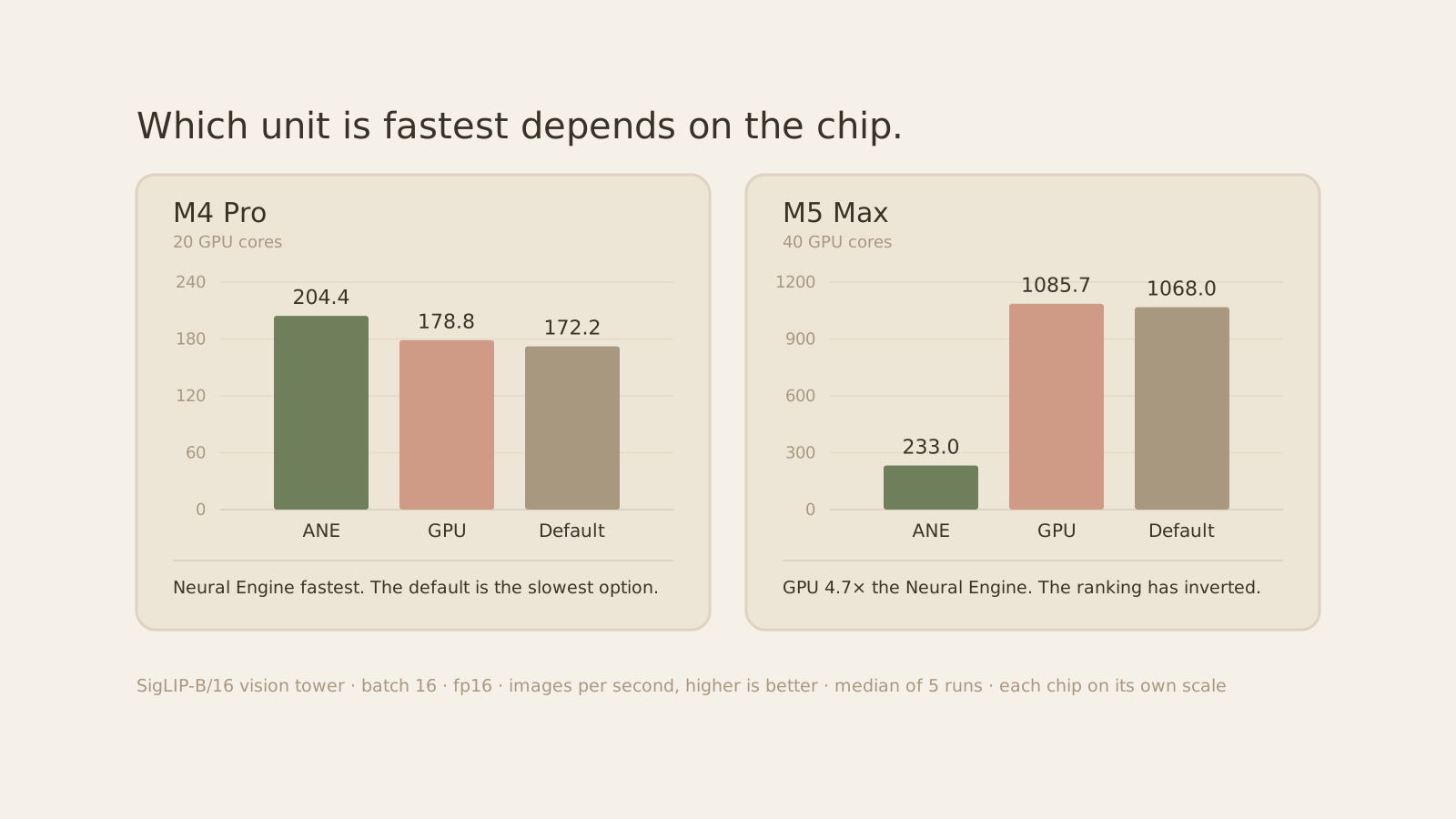
Core ML lets you name which engines a model may use, then decides the placement itself, reports success either way, and never says what it chose. This measures what it plans on Apple silicon and what each choice costs. Same model, same code: the Neural Engine beats the GPU on an M4 Pro and loses to it on an M5 Max.
The question
MLComputeUnits reads like a switch but behaves like an allow-list. You
can permit the Neural Engine, the GPU or both, and the runtime then places each
operation as it sees fit. No public API reports the outcome, so the usual advice,
leave it on the default and let Core ML decide, cannot be checked from inside an
app. This work checks it: the default (ALL) against the two explicit
choices, Neural Engine with CPU and GPU with CPU, on five models and two Apple
silicon configurations.
Method
Five models converted with coremltools 9.0 to fp16 ML programs at batch 16:
SigLIP base, ResNet-50, MobileNetV2, DistilBERT, and the Whisper tiny encoder. The
hardware is three M4 Pro Mac minis and one M5 Max MacBook Pro. Throughput is the
median of repeated burst runs; sustained behaviour comes from 120- and 600-second
soaks measured in windows. Placement is read from Core ML's own
MLComputePlan, weighted by cost. That is the runtime's plan, not a
trace of execution, and the write-up says so wherever it matters.
The repository is the instrument as much as the result: one script reproduces the benchmarks on any Apple silicon Mac and prints a table ready to paste into an issue, a placement check can fail a CI job when a model stops landing on the Neural Engine, and the paper's figures are recomputed from the committed results files in CI, so a claim that drifts from its data fails the build.
What it found
The faster engine flips between the two configurations on three of the five models. On SigLIP the Neural Engine is 1.14× faster than the GPU on the M4 Pro; on the M5 Max the GPU runs 1,077.7 images a second against the Neural Engine's 232.9, about 4.6×. Between the two, the Neural Engine gains 1.09 to 1.18× and the GPU 2.89 to 6.31×. MobileNet, usually held up as the Neural Engine's best case, is faster on the GPU on both.
The default is not a safe middle. On the M4 Pro it splits work across engines on four of the five models, and on three of them it is slower than either explicit choice:
| M4 Pro, images/s | Default | Neural Engine | GPU |
|---|---|---|---|
| SigLIP | 172.2 | 204.4 | 178.8 |
| ResNet-50 | 386.1 | 929.6 | 659.5 |
| Whisper tiny encoder | 28.0 | 56.3 | 145.1 |
On the M5 Max the default puts everything on the GPU and costs only 1.01 to 1.09×. Over time the picture moves again: the Neural Engine gives back at most 0.14% under sustained load in 41 of 42 soaks, while the GPU gives back 1.1 to 13.2% on the M4 Pro and 4.8 to 16.3% on the M5 Max. On SigLIP the M5 Max GPU's lead falls from 4.38× in the first ten seconds to 3.67× by the end of a soak.
What it does not show
Two configurations are not a population, and each pairs a chip with a different macOS build, so chip and operating system cannot be separated. That is why the paper keeps a hardware explanation for the inversion but withdraws it for the cost of the default, and why the conclusion is stated per configuration: placement has to be measured on the machine it will run on. There is no decoder-only language model in the set, which is the largest gap, and Python call overhead is inside every figure.
Release
Version 2.0.0, released 30 August 2026 under the MIT licence, with the paper, tools and every results file in the repository. The DOI below always resolves to the newest release.
Repository and full results on GitHub DOI 10.5281/zenodo.22136103